blue living room ideas images I found:
Krak des Chevaliers, NW Syria
Image by james_gordon_losangeles
Krak des Chevaliers is a Crusader castle in Syria and one of the most important preserved medieval castles in the world. The site was first inhabited in the 11th century by a settlement of Kurds; as a result it was known as Hisn al Akrad, meaning the "Castle of the Kurds". In 1142 it was given by Raymond II, Count of Tripoli, to the Knights Hospitaller. It remained in their possession until it fell in 1271. It became known as Crac de l'Ospital; the name Krak des Chevaliers was coined in the 19th century.
The Hospitallers began rebuilding the castle in the 1140s and were finished by 1170 when an earthquake damaged the castle. The order controlled a number of castles along the border of the County of Tripoli, a state founded after the First Crusade. Krak des Chevaliers was amongst the most important and acted as a centre of administration as well as a military base. After a second phase of building was undertaken in the 13th century, Krak des Chevaliers became a concentric castle. This phase created the outer wall and gave the castle its current appearance. The first half of the century has been described as Krak des Chevaliers' "golden age". At its peak, Krak des Chevaliers housed a garrison of around 2,000. Such a large garrison allowed the Hospitallers to extract tribute from a wide area. From the 1250s the fortunes of the Knights Hospitaller took a turn for the worse and in 1271 Krak des Chevaliers was captured by the Mamluk Sultan Baibars after a siege lasting 36 days.
Renewed interest in Crusader castles in the 19th century led to the investigation of Krak des Chevaliers, and architectural plans were drawn up. In the late 19th or early 20th century a settlement had been created within the castle, causing damage to its fabric. The 500 inhabitants were moved in 1933 and the castle was given over to the French state, under which a programme of clearing and restoration was carried out. When Syria declared independence in 1946, the castle left French control. Krak des Chevaliers is located approximately 40 kilometres (25 mi) west of the city of Homs, close to the border of Lebanon, and is administratively part of the Homs Governorate. Since 2006, the castles of Krak des Chevaliers and Qal'at Salah El-Din have been recognised by UNESCO as a World Heritage Site.
The modern Arabic name for the castle is Qalaat el Hosn, which translates as "stronghold castle"; this derives from the name of an earlier fortification on the site called Hisn el Akrad, meaning stronghold of the Kurds.It was called by the Franks Le Crat and then by a confusion with karak (fortress), Le Crac. Crat was probably the Frankish version of Akrad, the word for Kurds. After the Knights Hospitaller took control of the castle, it became known as Crac de l'Ospital; the name Crac des Chevaliers (alternatively spelt Krak des Chevaliers) was introduced by Guillaume Rey in the 19th century.
Location
The castle sits atop a 650-metre (2,130 ft) high hill east of Tartus, Syria, in the Homs Gap.[5] On the other side of the gap, 27 kilometres (17 mi) away, was the 12th-century Gibelacar Castle. The route through the strategically important Homs Gap connects the cities of Tripoli and Homs. To the north of the castle lies the Jebel Ansariyah, and to the south Lebanon. The surrounding area is fertile, benefiting from streams and abundant rainfall.
Compared to the Kingdom of Jerusalem, the other Crusader states had less land suitable for farming; however, the limestone peaks of Tripoli were well-suited to defensive sites.
Property in the County of Tripoli granted to the Knights Templar in the 1140s included the Castle of the Kurds, the towns of Rafanea and Montferrand, and the Buqai'ah plain separating Homs and Tripoli. Homs was never under Crusader control, so the region around the Castle of the Kurds was vulnerable to expeditions from the city. While its proximity caused the Knights problems with regard to defending their territory, it also meant it was close enough for them to raid. Because of its command of the plain, the castle became the Knights' most important base in the area.
History
The Levant in 1135 (left), with Crusader states marked by a red cross and the region in 1190 (right)
According to Arab documents, the site of the later castle was first occupied in 1030 by a group of Kurds; it was from this settlement that the site derived its name. When building castles, Muslims often chose high sites such as hills and mountains that provided natural obstacles. While journeying towards Jerusalem in January 1099, the company of Raymond IV of Toulouse came under attack. The garrison of al-Akrad harried Raymond's foragers.The following day he marched on the castle and found it deserted. The Franks briefly occupied the castle in February but abandoned when they continued their march towards Jerusalem. Permanent occupation began in 1110 when Tancred, Prince of Galilee took control of the site. The early castle was very different from the extant remains. No trace of this first castle on the site survives.
The origins of the Knights Hospitaller are unclear, but the order probably emerged around the 1070s in Jerusalem. It started as a religious order which cared for the sick, and later looked after pilgrims to the Holy Land. After the success of the First Crusade in capturing Jerusalem in 1099, many crusaders donated their new property in the Levant to the Hospital of St John. Early donations were in the newly formed Kingdom of Jerusalem, but over time the Order extended its holdings to the Crusader states of the County of Tripoli and the Principality of Antioch. Evidence suggests that in the 1130s the order was becoming militarised in 1136 Fulk, King of Jerusalem, granted the newly built castle at Bethgibelin to the order and a papal bull from between 1139 and 1143 may indicate the order was hiring people to defend pilgrims. There were other military orders, such as the Order of the Temple, which offered protection to pilgrims.
From Guillaume Rey Étude sur les monuments de l'architecture militaire des croisés en Syrie et dans l'île de Chypre (1871).
Between 1142 and 1144 Raymond II, Count of Tripoli, granted the order property in the County. According to historian Jonathan Riley-Smith, the Hospitallers effectively established a "palatinate" within Tripoli. The property included castles with which the Knights Templar were expected to defend Tripoli. Including Krak des Chevaliers, the Hospitallers were given five castles along the borders of the state. The order's agreement with Raymond II allowed them to dominate the area; if Raymond II did not accompany the Knights on campaign, the spoils belonged entirely to the order, and if he was present it was split equally between the count and the order. Raymond II also could not make peace with the Muslims without the permission of the Hospitallers. The Hospitallers made Krak des Chevaliers a centre of administration for their new property. The work they undertook at the castle would make it one of the most elaborate Crusader fortifications in the Levant.
After acquiring the site in 1142, they began building a new castle, replacing the Kurdish fortification. The work lasted until 1170, when an earthquake damaged the castle. An Arab source mentions the quake destroyed the castle's chapel. It was replaced with the present chapel. In 1163 the Crusaders were victorious over Nur ad-Din in the Battle of al-Buqaia near Krak des Chevaliers.
Drought conditions between 1175 and 1180 prompted the Crusaders to sign a two-year truce with the Muslims, but Tripoli was not included in the terms. During the 1180s raids by Christians and Muslims into each other's territory became more frequent. In 1180, Saladin ventured into the County of Tripoli, ravaging the area. Unwilling to meet him in open battle, the Crusaders retreated to the relative safety of their fortifications. Without capturing the castles, Saladin could not secure control of the area, and once he retreated the Hospitallers were able to revitalise their damaged lands. The Battle of Hattin in 1187 was a disastrous defeat for the Crusaders: Guy of Lusignan, King of Jerusalem, was captured, as was the True Cross, a relic discovered during the First Crusade. Afterwards Saladin ordered the execution of the captured Templar and Hospitaller knights, such was the importance of the two orders in defending the Crusader states. After the battle, the Hospitaller castles of Belmont, Belvoir, and Bethgibelin fell to Muslim armies. Following these losses, the Order focussed its attention on its castles in Tripoli. In May 1188 Saladin led an army to attack Krak des Chevaliers, but on seeing the castle decided it was too well defended and marched on the Hospitaller castle of Margat, which he also failed to capture.
Another earthquake struck in 1202, and it may have been after this event that the castle was remodelled. The 13th-century work was the last period of building at Krak des Chevaliers and gave it its current appearance. An enclosing stone circuit was built between 1142 and 1170; the earlier structure became the castle's inner court or ward. If there was a circuit of walls surrounding the inner court that pre-dated the current outer walls, no trace of it has been discovered.
The first half of the 13th century has been characterised as Krak des Chevaliers' "golden age". While other Crusader strongholds were under threat, Krak des Chevaliers and its garrison of 2,000 soldiers dominated the surrounding area. It was effectively the centre of a principality which remained in Crusader hands until 1271 and was the only major inland area to remain constantly under Crusader control in this period. Crusaders passing through the area would often stop at the castle, and probably made donations. King Andrew II of Hungary visited in 1218 and proclaimed the castle was the "key of the Christian lands". He was so impressed with the castle he gave a yearly income of 60 marks to the Master and 40 to the brothers. Geoffroy de Joinville, uncle of the famous chronicler of the Crusades Jean de Joinville, died at Krak des Chevaliers in 1203 or 1204 and was buried within the castle's chapel.
The main contemporary sources relating to Krak des Chevaliers were written by Muslims. They tend to emphasise Muslim success and overlook setbacks against the Crusaders, but they suggest that the Knights Hospitaller forced the settlements of Hama and Homs to pay tribute to the order. This situation lasted as long as Saladin's successors warred between themselves. The proximity of Krak des Chevaliers to Muslim territories allowed it to take on an offensive role, acting as a base from which neighbouring areas could be attacked. By 1203 the garrison were making raids on Montferrand (which was under Muslim control) and Hama, and in 1207 and 1208 the castle's soldiers took part in an attack on Homs. Krak des Chevaliers acted as a base for expeditions to Hama in 1230 and 1233 after the amir refused to pay tribute. The former was unsuccessful, but the 1233 expedition was a show of force that demonstrated the importance of Krak des Chevaliers.
In the 1250s, the fortunes of the Hospitallers at Krak des Chevaliers took a turn for the worse. An army estimated to number 10,000 men ravaged the country around the castle in 1252. After this, it seems the order's finances were badly affected. In 1268 Master Hugh Revel complained that the area, which had previously been home to around 10,000 people, was deserted and the order's property in the Kingdom of Jerusalem was producing little income; he also noted that by this point there were only 300 of the order's brothers left in the east. On the Muslim side, a new Sultan, Baibars, seized power in 1260 and united Egypt and Syria. One of the effects was that Muslim settlements which had previously paid tribute to the Hospitallers at Krak des Chevaliers were no longer intimidated into doing so.
Baibars ventured in the area around Krak des Chevaliers in 1270 and allowed his men to graze their animals on the fields around the castle. When he received news that year that King Louis IX of France was leading the Eighth Crusade, Baibars left for Cairo. Louis died in 1271 and Baibars returned north to deal with Krak des Chevaliers. Before marching on the castle he captured the smaller castles in the area, including Chastel Blanc. On 3 March, Baibars' army arrived at Krak des Chevaliers. By the time the Sultan arrived the castle may already have been blockaded by Mamluk forces for several days. There are three Arabic accounts of the siege; only one, that of Ibn Shaddad, was by a contemporary although he was not present. Peasants who lived in the area had fled to the castle for safety and were kept in the outer ward. As soon as Baibars arrived he began erecting mangonels, powerful siege weapons which he would turn on the castle. According to Ibn Shaddad, two days later the first line of defences was captured by the besiegers; he was probably referring to a walled suburb outside the castle's entrance.
Rain interrupted the siege, but on 21 March a triangular outwork immediately south of Krak des Chevaliers, possibly defended by a timber palisade, was captured. On 29 March, the tower in the south-west corner was undermined and collapsed. Baibars' army attacked through the breach and on entering the outer ward where they encountered the peasants who had sought refuge in the castle. Though the outer ward had fallen, and in the process a handful of the garrison killed, the Crusaders retreated to the more formidable inner ward. After a lull of ten days, the besiegers conveyed a letter to the garrison, supposedly from the Grand Master of the Knights Hospitaller in Tripoli which granted permission for them to surrender. Although the letter was a forgery, the garrison capitulated and the Sultan spared their lives. The new owners of the castle undertook repairs, focussed mainly on the outer ward. The Hospitaller chapel was converted to a mosque and two mihrabs were added to the interior.
Later history
After the Franks were driven from the Holy Land in 1291, European familiarity with the castles of the Crusades declined. It was not until the 19th century that interest in these buildings was renewed, so there are no detailed plans from before 1837. Guillaume Rey was the first to scientifically study Crusader castles in the Holy Land. In 1871 he published the work Etudes sur les monuments de l'architecture militaire des Croisés en Syrie et dans l'ile de Chypre; it included plans and drawings of the major Crusader castles in Syria, including Krak des Chevaliers. In some instances his drawings were inaccurate, however for Krak des Chavaliers they record features which have since been lost.
Paul Deschamps visited the castle in February 1927. Since Rey had visited in the 19th century a village of 500 people had been established within the castle. Renewed inhabitation had damaged the site: underground vaults had been used as rubbish tips and in some places the battlements had been destroyed. Deschamps and fellow architect François Anus attempted to clear some of the detritus; General Maurice Gamelin assigned 60 Alawite soldiers to help. Deschamps left in March 1927, and work resumed when he returned two years later. The culmination of Deschamp's work at the castle was the publication of Les Châteaux des Croisés en Terre Sainte I: le Crac des Chevaliers in 1934, with detailed plans by Anus.[36] The survey has been widely praised, described as "brilliant and exhaustive" by military historian D. J. Cathcart King in 1949[2] and "perhaps the finest account of the archaeology and history of a single medieval castle ever written" by historian Hugh Kennedy in 1994.
As early as 1929 there were suggestions that the castle should be taken under French control. On 16 November 1933 Krak des Chevaliers was given into the control of the French state, and cared for by the Académie des Beaux-Arts. The villagers were moved and paid F1 million between them in compensation. Over the following two years a programme of cleaning and restoration was carried out by a force of 120 workers. Once finished, Krak des Chevaliers was one of the key tourist attractions in the French Levant. Pierre Coupel, who had undertaken similar work at the Tower of the Lions and the two castles at Sidon, supervised the work. Despite the restoration, no archaeological excavations were carried out. The French Mandate of Syria and Lebanon, which had been established in 1920, ended in 1946 with the declaration of Syrian independence. The castle was made a World Heritage Site by UNESCO, along with Qal’at Salah El-Din, in 2006,[1] and is owned by the Syrian government. During the Syrian uprising which began in 2011 UNESCO voiced concerns that the conflict might lead to the damage of important cultural sites such as Krak des Chevaliers. It has been reported that the castle has been shelled by the Syrian army, and that the Crusader chapel has been damaged.
Architecture
Writing in the early 20th century, T. E. Lawrence, popularly known as Lawrence of Arabia, remarked that Krak des Chevaliers was perhaps the best preserved and most wholly admirable castle in the world, [a castle which] forms a fitting commentary on any account of the Crusading buildings of Syria. Castles in Europe provided lordly accommodation for their owners and were centres of administration; in the Levant the need for defence was paramount and was reflected in castle design. Kennedy suggests that The castle scientifically designed as a fighting machine surely reached its apogee in great buildings like Margat and Crac des Chevaliers.
Krak des Chevaliers can be classified both as a spur castle, due to its site, and after the 13th-century expansion a fully developed concentric castle. It was similar in size and layout to Vadum Jacob, a Crusader castle built in the late 1170s. Margat has also been cited as Krak des Chevaliers' sister castle. The main building material at Krak des Chevaliers was limestone; the ashlar facing is so fine that the mortar is barely noticeable. Outside the castle's entrance was a "walled suburb" known as a burgus, although no trace of it remains. To the south of the outer ward was a triangular outwork and the Crusaders may have intended to build stone walls and towers around it. It is unknown how it was defended at the time of the 1271 siege, though it has been suggested it was surrounded by a timber palisade. South of the castle the spur on which it stands is connected to the next hill, so that siege engines can approach on level ground. The inner defences are strongest at this point, with a cluster of towers connected by a thick wall.
Between 1142 and 1170 the Knights Hospitaller undertook a building programme on the site. The castle was defended by a stone curtain wall studded with square towers which projected slightly. The main entrance was between two towers on the eastern side, and there was a postern gate in the north-west tower. At the centre was a courtyard surrounded by vaulted chambers. The lay of the land dictated the castle's irregular shape. A site with natural defences was a typical location for Crusader castles and steep slopes provided Krak des Chevaliers with defences on all sides bar one, where the castle's defences were concentrated. This phase of building was incorporated into the later castle's construction.
When Krak des Chevaliers was remodelled in the 13th century, new walls surrounding the inner court were built. They followed the earlier walls, with a narrow gap between them in the west and south which was turned into a gallery from which defenders could unleash missiles. In this area, the walls were supported by a steeply sloping glacis which provided additional protection against both siege weapons and earthquakes. Four large, round towers project vertically from the glacis; they were used as accommodation for the Knights of the garrison, about 60 at its peak. The south-west tower was designed to house the rooms of the Grand Master of the Knights Hospitaller. Though the defences which once crested the walls of the inner wards no longer survive in most places, it seems that they did not extend for the entire circuit. Machicolations were absent from the southern face. The area between the inner court and the outer walls was narrow and not used for accommodation. In the east, where the defences were weakest, there was an open cistern filled by an aqueduct. It acted both as a moat and water supply for the castle.
At the north end of the small courtyard is a chapel and at the southern end is an esplanade. The esplanade is raised above the rest of the courtyard; the vaulted area beneath it would have provided storage and could have acted as stabling and shelter from missiles. Lining the west of the courtyard is the hall of the Knights. Though probably first built in the 12th century, the interior dates from the 13th-century remodelling. The tracery and delicate decoration is a sophisticated example of Gothic architecture, probably dating from the 1230s.
Chapel
The current chapel was probably built to replace the one destroyed by an earthquake in 1170. Only the east end of the original chapel, which housed the apse, and a small part of the south wall survive from the original chapel. The later chapel had a barrel vault and an uncomplicated apse; its design would have been considered outmoded by contemporary standards in France, but bears similarities to that built around 1186 at Margat. It was divided into three roughly equal bays. A cornice runs round the chapel at the point where the vault ends and the wall begins. Oriented roughly east to west, it was 21.5 metres (71 ft) long and 8.5 metres (28 ft) wide with the main entrance from the west and a second smaller one in the north wall. When the castle was remodelled in the early 13th century, the entrance was moved to the south wall. The chapel was lit by windows above the cornice, one at the west end, one on either side of the east bay, and one on the south side of the central bay, and the apse at the east end had a large window. In 1935 a second chapel was discovered outside the castle's main entrance, however it no longer survives.
Outer ward
The second phase of building work undertaken by the Hospitallers began in the early 13th century and lasted decades. The outer walls were built in the last major construction on the site, lending the Krak des Chevaliers its current appearance. Standing 9 metres (30 ft) high, the outer circuit had towers that projected strongly from the wall. While the towers of the inner court had a square plan and did not project far beyond the wall, the towers of the 13th-century outer walls were rounded. This design was new and even contemporary Templar castles did not have rounded towers. The technique was developed at Château Gaillard in France by Richard the Lionheart between 1196 and 1198. The extension to the south-east is of lesser quality than the rest of the circuit and was built at an unknown date. Probably around the 1250s a postern was added to the north wall.
Arrow slits in the walls and towers were distributed to minimise the amount of dead ground around the castle. Machicolations crowned the walls, offering defenders a way to hurl projectiles towards enemies at the foot of the wall. They were so cramped archers would have had to crouch inside them. The box machicolations were unusual: those at Krak des Chevaliers were more complex that those at Saône or Margat and there were no comparable features amongst Crusader castles. However, they bore similarities to Muslim work, such as the contemporary defences at the Citadel of Aleppo. It is unclear which side imitated the other, as the date they were added to Krak des Chevaliers is unknown, but it does provide evidence for the diffusion of military ideas between the Muslim and Christian armies. These defences were accessed by a wall-walk known as a chemin de ronde. In the opinion of historian Hugh Kennedy the defences of the outer wall were "the most elaborate and developed anywhere in the Latin east ... the whole structure is a brilliantly designed and superbly built fighting machine.
When the outer walls were built in the 13th century the main entrance was enhanced. A vaulted corridor led uphill from the outer gate in the north-east. The corridor made a hairpin turn halfway along its length, making it an example of a bent entrance. Bent entrances were a Byzantine innovation, but that at Krak des Chevaliers was a particularly complex example. It extended for 137 metres (450 ft), and along its length were murder-holes which allowed defenders to shower attackers with missiles. Anyone going straight ahead rather following the hairpin turn would emerge in the area between the castle's two circuits of walls. To access the inner ward, the passage had to be followed round.
Frescoes
Despite its predominantly military character, the castle is one of the few sites where Crusader art (in the form of frescoes) has been preserved. In 1935, 1955, and 1978 medieval frescoes were discovered within Krak des Chevaliers after later plaster and white-wash had decayed. They were painted on the interior and exterior of the main chapel, the chapel outside the main entrance which no longer survives. Writing in 1982, historian Jaroslav Folda noted that at the time there had been little investigation of Crusader frescoes which would provide a comparison for the fragmentary remains found at Krak des Chevaliers. Those in the chapel were painted on the masonry from the 1170–1202 rebuild. Mould, smoke, and moisture have made it difficult to preserve the frescoes. The fragmentary nature of the red and blue frescoes inside the chapel means they are difficult to assess. The one on the exterior of the chapel depicted the Presentation of Jesus at the Temple.

Calm Collected Comical Chaos - Grief
Image by Boogies with Fish
www.messersmith.name/wordpress/2010/12/04/calm-collected-...
Grief . . . It's a funny thing. No, not funny - ha-ha; it's an odd thing that it is so very common - we all do it sooner or later - but we do it in such extremely different ways. Now, you may be thinking, "Oh no, here we go again." And, you're right. Here I go again, but with a twist. Some things we simply have to laugh about, because if we don't, we get all depressed, bitter and twisted. So, today I'm going to laugh.
Like most Westerners, my concept of grief included things such as plenty of nice deep depression, an acute sense of loss, gobs and gobs of denial, much sniffling and dabbing of eyes and the occasional crying jag. More pronounced but harmful symptoms such as suicidal thoughts and intense anger are common but are usually unseen by those surrounding the griever. That was my idea of grief until I witnessed the aftermath of a death in a Papua New Guinean village.
Wow, you've probably never witnessed such scenes - well, maybe in movies. Believe me, movies can't convey that kind of emotional chaos. You have to see it first-hand. You have to hear it, the wailing which goes on interminably, the drums beating all night. You have to smell it, the stench of animal fat and plant juices smeared on sweaty bodies. I felt embarrassed. The staggering around, the rolling in the dirt, the screaming and shouting, the moans and tears, the trembling, the falling into camp-fires. I kept wanting to shout, "Hey, hold on there. You're going to hurt yourself!" It was horrible. I didn't get the point of it. That's it all right. It seemed pointless to me. And it went on for a couple of days with brief periods of exhaustion.
One might well ask, "What's funny about that?" Well, nothing, I admit. Until it happens to you. It's taken me a few days to calm down enough to look back on it to see the irony of my experience. Before Tuesday morning it all seemed a tiny bit fake to me - like a public demonstration of sadness and loss which is Politically Correct. If one doesn't participate it is considered callous and uncaring. Proper respect must be paid.
I kept a pretty stiff upper lip through the two memorial services, grieving in the Western way, hunched, sobbing occasionally, gratefully accepting the ministrations of lady friends on each side holding a hand or draping a comforting arm around my shoulders. It was very proper and convincing. I was certainly convinced at the time. However, in the end it was strangely uncompelling, unfulfilling, unmoving and a whole lot of other un-somethings which I can't seem to get from my brain to the keyboard. I will not take a thing from those experiences. I won't spoil them by lessening their importance. Those ceremonies were not for me. They were for Eunie. However they did not come anywhere near satisfying my need to grieve for her. There's another un - unsatisfied.
Many people warned me. "It hasn't hit you yet." Now I get it. I learned all about it in one morning. I don't know how to rank it alongside other powerful experiences in my life. It was absolutely unique. It wasn't much fun, but I am so glad that it happened.
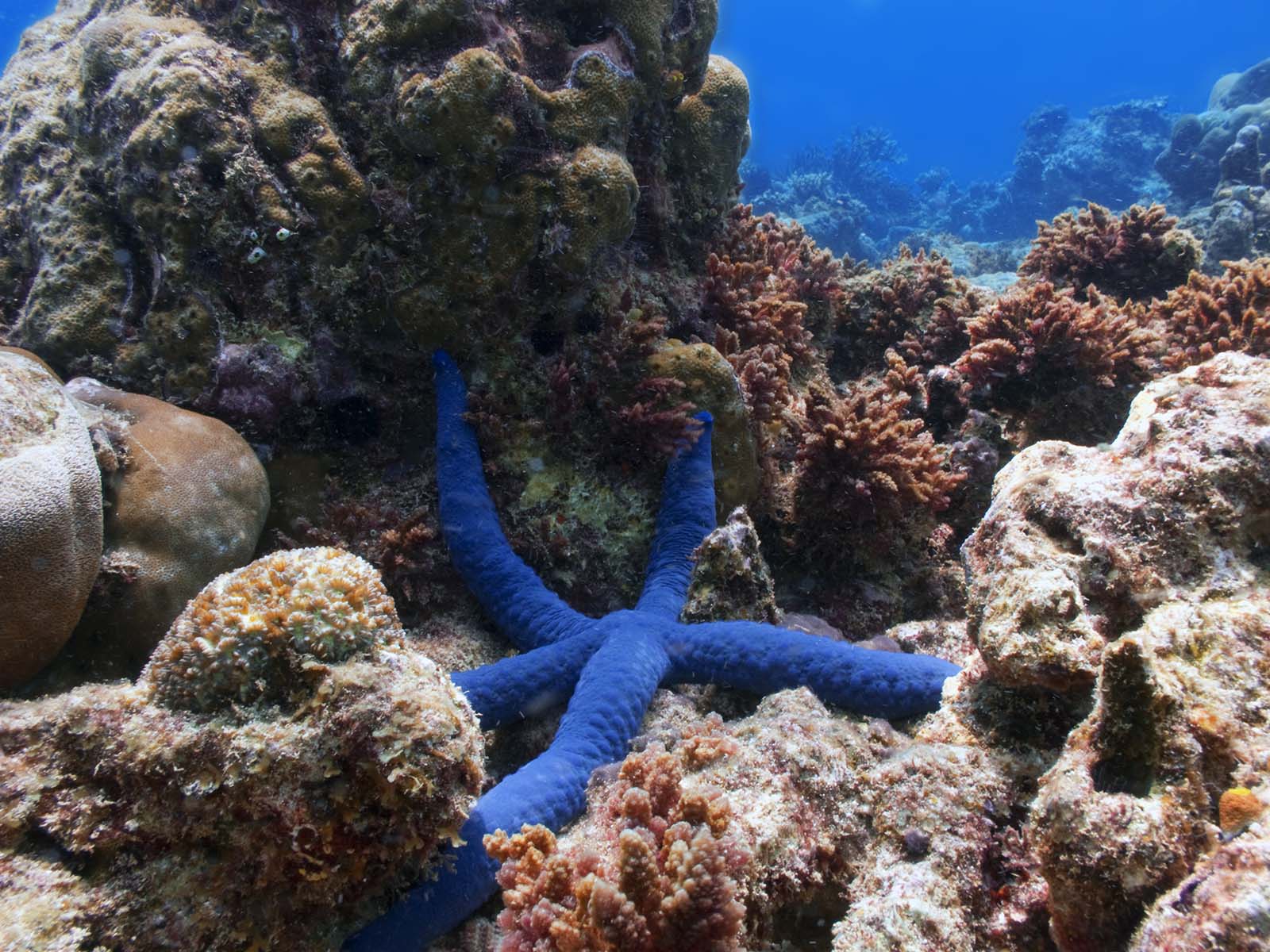
Because I'm feeling calmer now and I want to run with that, here is a nice peaceful reef scene with my favourite starfish, the highly improbable Linckia laevigata:
The morning did not start well. I called in sick. At some point I sat down at the computer to compose the words for Eunie's tombstone. Yes, I know that's been a long time coming, but it's a logistical problem. You cannot get anything like that made in PNG, at least not what I wanted. I had a mild sense of foreboding, but I told myself sternly (doing that a lot these days), "Hey, you're a writer. So sit down and write something. It's not War and Peace."
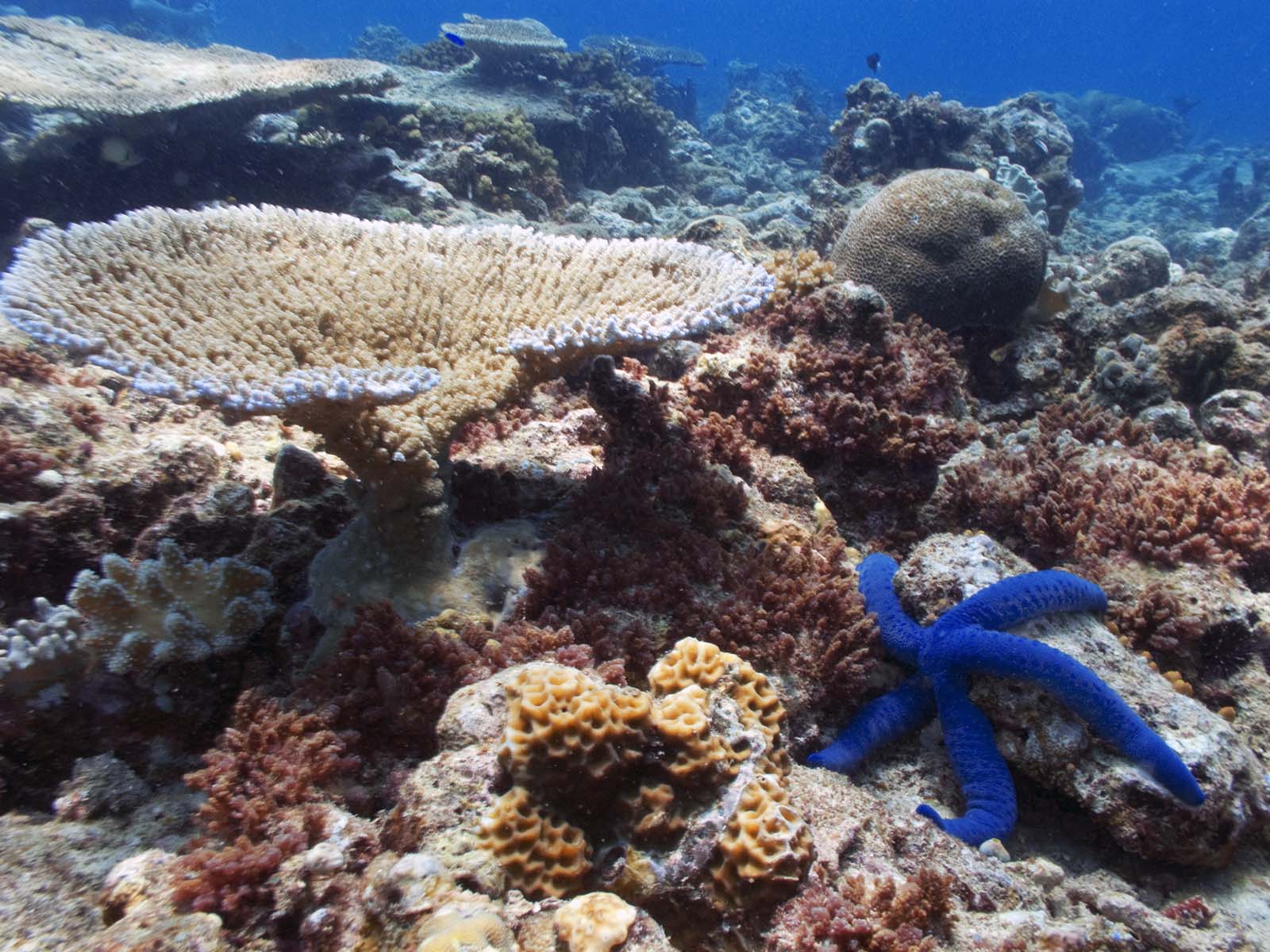
So, I sat down to write. Here's another L. laevigata:
Nothing that I wanted so much came to mind. I desperately needed to get the job done. Nothing but frustration . . . What a fine time for writer's block. Suddenly something wild pounced upon me like a wolf ravaging a carcass. It blew me away. I was Pooh Bear on The Blustery Day.
Okay, what I'm going to describe is not pretty. Keep in mind that I'm in a very calm and bemused state of mind right now and I'm standing outside myself looking in. It was a good thing. It was needed. Still, you may not want to read about it. That's okay. I'm putting these words here because I need to. If nobody reads them . . . well, that's okay too.
It went on and on. I couldn't stop it. Crying isn't the word for it. It was more like wailing - yeah, wailing and moaning and . . . screaming. I can't ever remember screaming before in my whole crazy life. How can that happen? How can you get through life without screaming once in a while? Now I get that too. I get screaming. Oh, yeah, baby. I get screaming. We all need to do it more often. It's very refreshing.
And then there was the staggering around and bumping into things. And yes, the falling down. And the pounding of the fists against anything handy, like a head or the floor or the wall or whatever. And the head banging, now I finally dig that one too - the head banging. I couldn't stop. I started getting scared.
And then something really silly happened. I started yawning. I have seldom yawned in the last few months. What's with that? So, between racking sobs I experienced a seemingly endless series of yawns that went way down to my soul, long earnest yawns which sent chills of wacky pleasure flowing from my scalp to my toes. You know the kind of yawns I'm talking about. Where did those come from? They seemed so incongruous, so unseemly, so . . . so stupid!
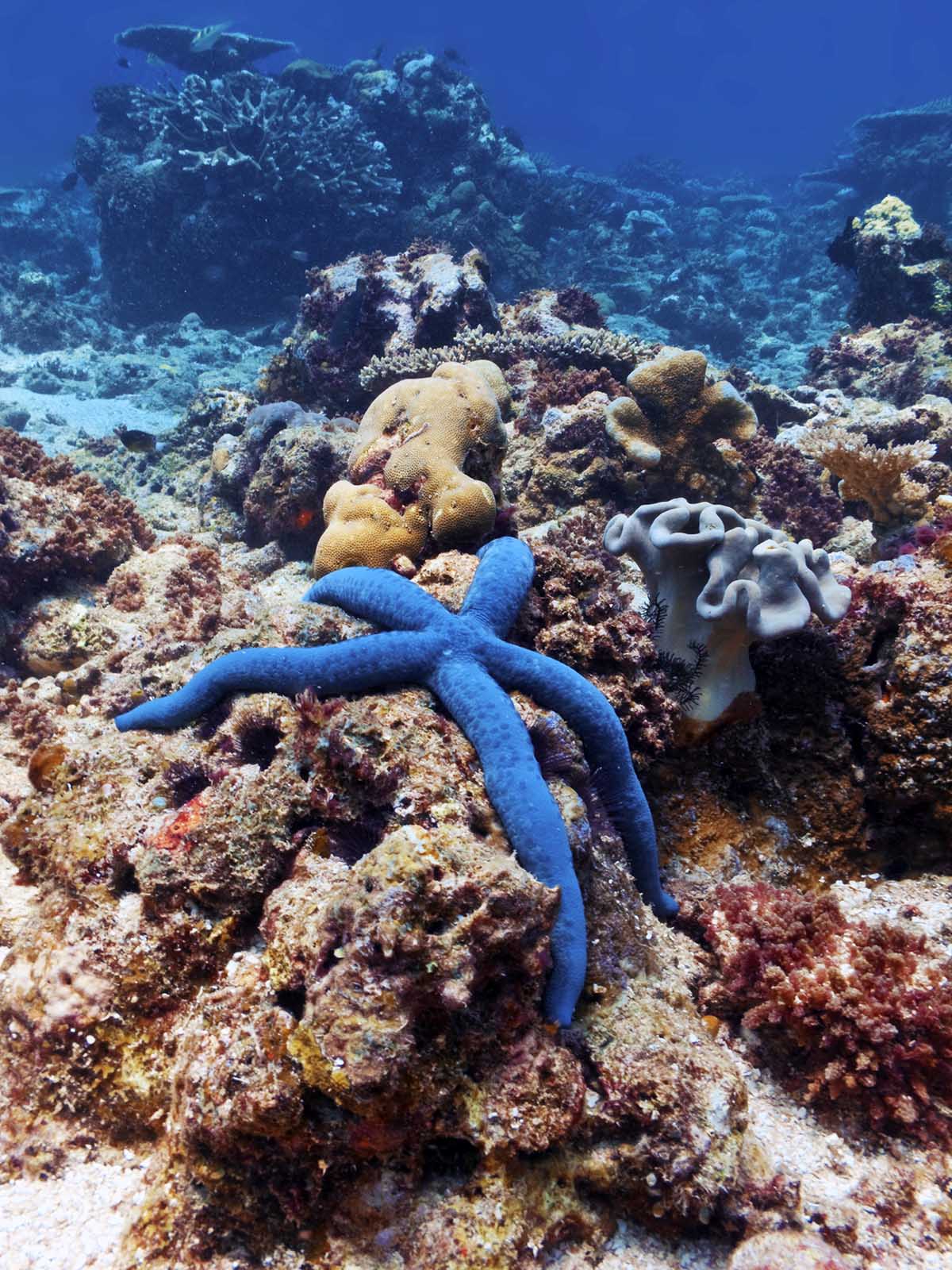
I managed to get my voice back enough to call the office to say that I wasn't coming in. I think that I scared my friend on the phone. He offered to come over. Let me catch my breath a moment. Here's yet another calm blue starfish. Really this blue toy looks as if it's just plain tired:
If I show enough of these I will put you to sleep. Don't spill your coffee.
I declined the offer of help because I knew exactly the kind of help I needed. I needed some tough love. some very tough love. I called Trevor. I'm not going to tell you everything that happened while I sat in the living room waiting for Trev to arrive. Some of it is too revealing. Some of it is embarrassing. I will admit that I did two things which are supposed to be a part of the grieving process, but I had decided to skip, because they seemed so pointless. I asked "Why? Oh, WHY?" and I got extremely angry with God. And yeah, in retrospect, both were pointless. Imagine that - getting all angry at God. It is to laugh. And asking why? WHY?? What a silly question. Everybody dies. It's part of the deal. What makes me so special that my wife shouldn't die? It's ridiculous. It doesn't require an explanation. Because. Just because. That's why.
The anger seems very comical. I'm too steeped in Christianity to curse God properly. The words wouldn't come. The sentences were too awful to complete. I'm now picturing Homer Simpson with his hand's around Bart's neck and Bart's tongue is sticking out and wiggling frantically and Homer is screaming, "Why, you . . . (sputter, sputter)". You get the picture. That's me - angry with God. A dear friend told me that she was very angry with God for a very long time after her husband died. I didn't get it. Now I do. I got over my anger pretty quickly. I ran out of energy. All of that grinding of the teeth and clenching of the fists wears a fellow down. It takes a lot of effort to stay angry with God.
You don't need any more details. That is not what this is about. This is about relief.
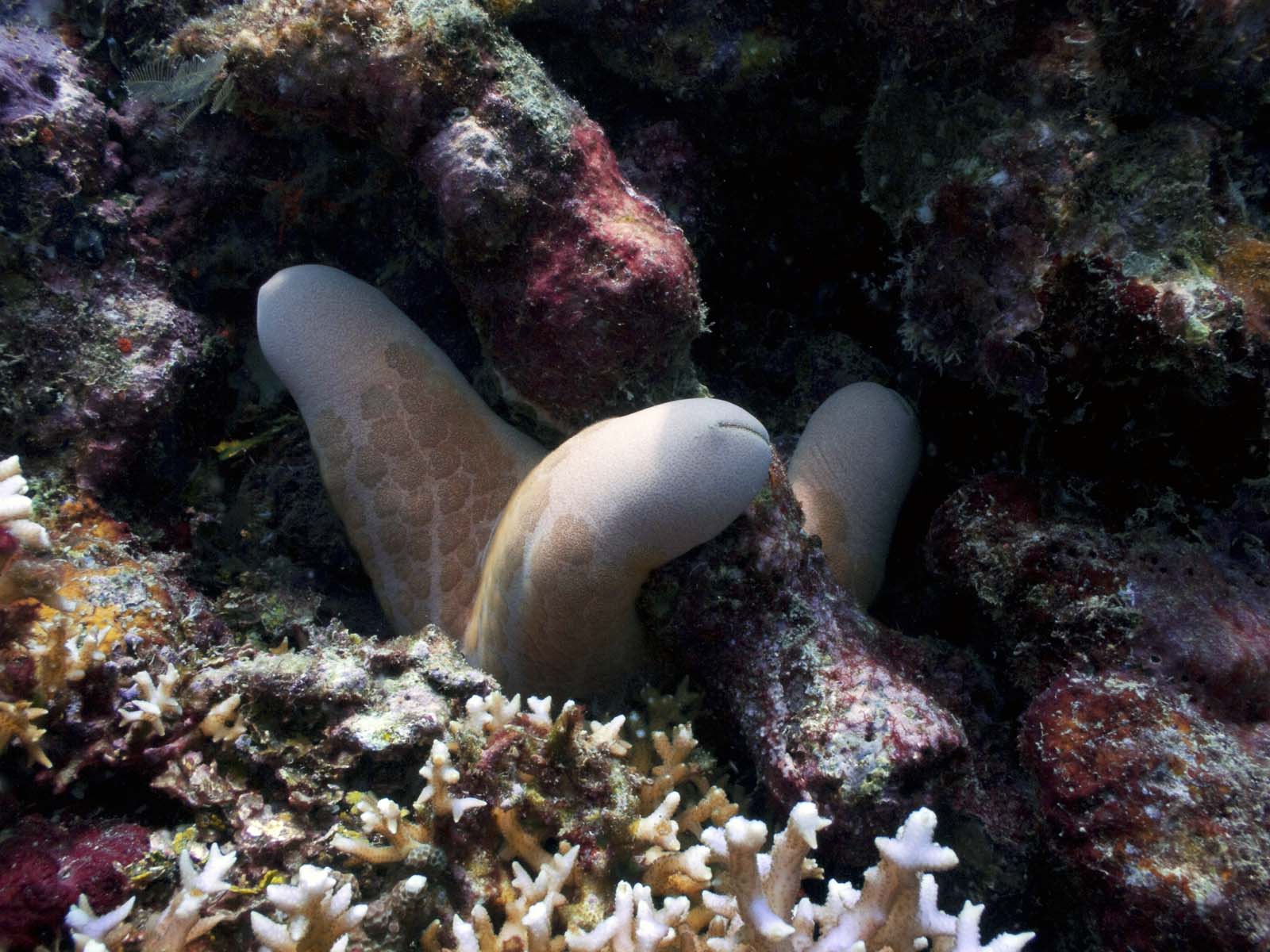
Here is another of my favourite starfish, a Choriaster granulatus:
I don't know how they get into these positions. They must practice Yoga. More about that later. You're going to have a good laugh. (Hee-hee)
Well, by the time Trev arrived I was in a sorry state. I wish he had taken a picture. I'd love to have it. My head was lumpy and my hands hurt. We sat there for a while and he calmed me down. It was some of the finest tough love I have ever received. I was still breaking out in fresh fits for a while. I distinctly remember hitting myself in the face very hard. Funny, I did not realise that it was possible for one to hit oneself in the face so hard. My jaw is still sore. Now I am getting a giggle from that as I think of it. It was like the classic movie scene in which some poor soul is plainly hysterical and gets a good hard slap from a friend who says, "Get control of yourself!" and the slapped person replies, "Thanks, I needed that."
Well, this story is growing too long, so I'd better wrap it up. I scared the neighbours something awful. When I came back to the house in the evening, after going for some Yoga (yes, I said Yoga), Sisilia and her niece were waiting for me with some food and serious looks on their faces. They are lovely people, my next door neighbours. I invited them into the house and we sat for a while. Though they were shaken and worried about me their attitude changed dramatically when I told them what it was all about. They were very approving and happy for me. It's the Papua New Guinian way. I was now acting like good person and properly showing my grief for my dead wife. See? A happy ending.
Now for the real fun.
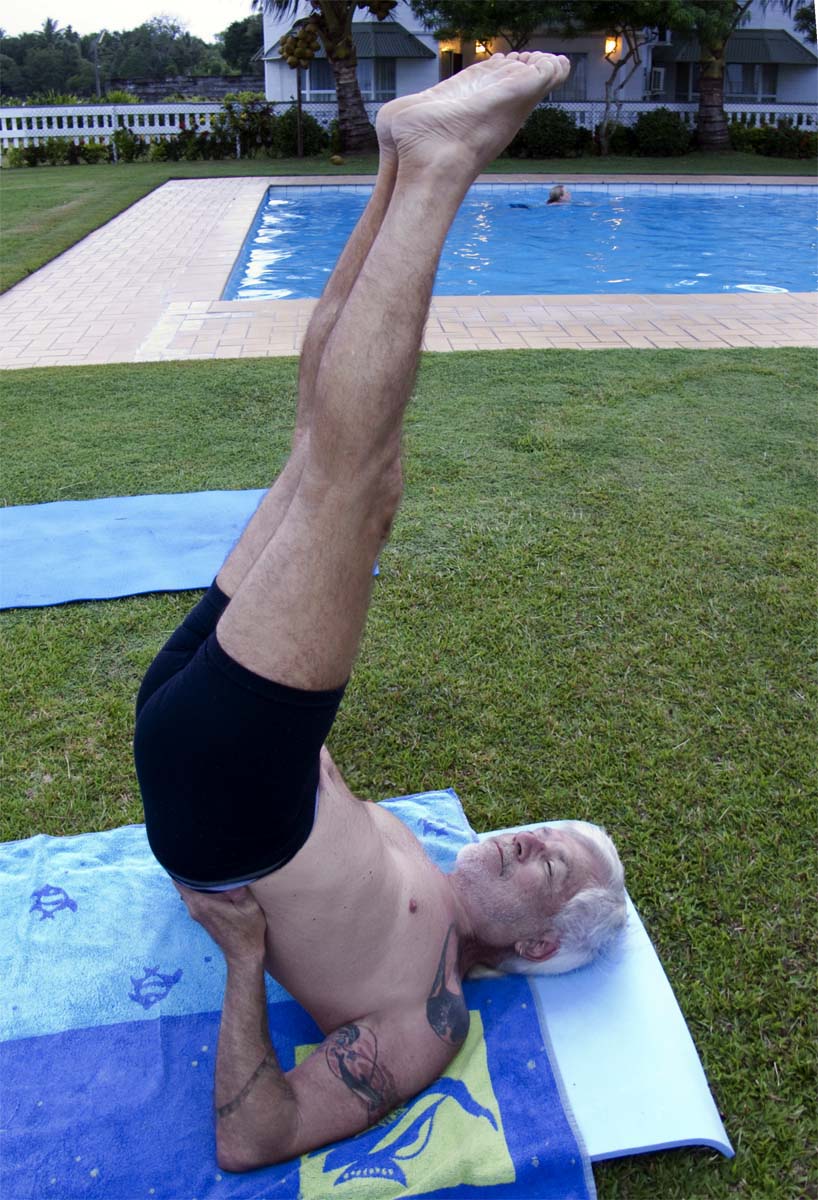
I have detected a tiny hint of jocular scepticism among certain friends whenever the word Yoga escapes my lips in connection with myself. I'm here to dispel that scoffing attitude. I went for some Yoga to help calm me down. I asked Michaela to take a couple of pictures of me in the less frightening positions.
I have never ascribed to the spiritual accoutrements of Yoga. I don't get it. However, I have practiced the physical exercises and contortions since I was a child. I'm Pretzel Man. I don't want to shock you with the more bizarre configurations of my body. You may be having your breakfast doughnut. I just want to demonstrate that I actually do Yoga. I don't pretend to do Yoga:
Yes, that is me. You might now be saying, "Yeah, well, anybody can do that."
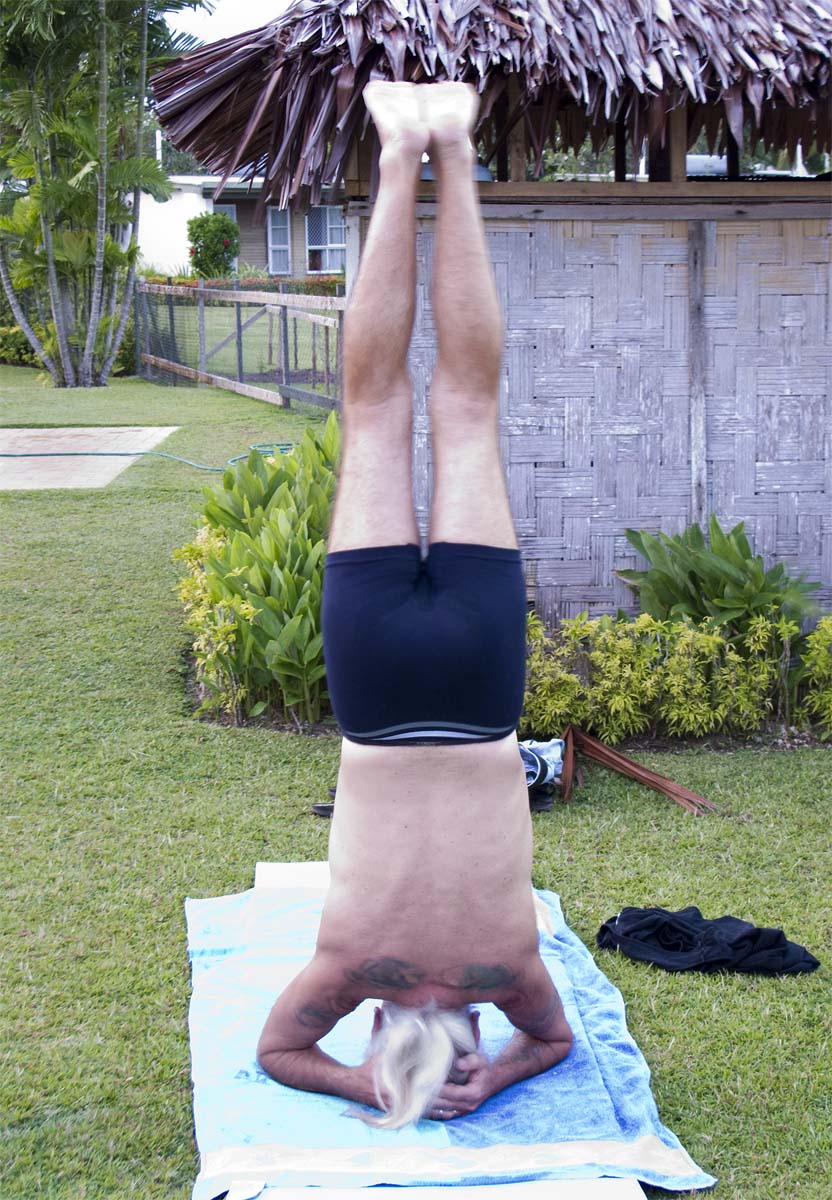
Yeah, well, can you do this?
This is also me - doing a head stand or, as I prefer to call it, a Tiger Stand.
If you don't find that funny then you need an attitude check.

Adventures of the lost glove
Image by runran
The trip started from my home in Nanaimo, BC – a burg just a little too big to be a pleasant place to live, with more malls spread along the highway than can really be needed, as if shopping is the only creative outlet for the 80 thousand or so souls who call the city home. Nanaimo’s downtown has been a ghost town for ages, with very few shops of note and a nightlife that includes junkies and slobbering drunks. To be honest, the well-heeled folk are better off venturing no further from suburbia than the closest mall.
Strangely, as vendors of clothing and accessories, Nanaimo has never cottoned to our style. We don’t sell the common brands that fuel box stores, preferring instead to flog handcrafted hats and bags and clothing, some imports and vintage. We set up our tent at street markets and music festivals in spring, summer and fall. In the winter months we set up booths at universities and colleges across Western Canada. The most recent trip took us as far as the prairie jewel, Saskatoon. Even at –30, the warm heart of the place was notable.
These journeys would provide rich material for any freelance journalist or photographer. The themes could be various. Why are so many Korean Christians working in the motel industry? Why do so many men who stay in motels dream of a better life? Why do motels persist in faking domestic environments? What do we feed our students? University and college food courts vary wildly, from the wonderful dhal at UVic’s International Grill, to the drab and damn-near poison offered by some food services. Which student body is the most stylish? The most addicted to mobile devices? The drunkest? There are endless slants on which to hook an article. But I rarely write freelance anymore. I blame my computer - just when a good idea crops up, I find a wireless connection and vanish into cyberspace.
Still, this last trip was remarkable enough to write a blog post and upload some altered snaps. There is also a particularly splendid experience that insists upon proper comment – all about manners. I know it’s not fair to say that one student body is on the whole kinder than another. But the students in Regina and Saskatoon are better mannered than any I’ve come across – particularly in Saskatoon. As an example, let me tell you about my wounded hand and a lost glove.
I will get to the wound. First, let me tell you about my gloves. They are expensive, made for construction workers who want both protection and flexibility. They are snug and well padded. I bought them because of a skin condition that’s exacerbated by my work. I constantly handle metal clothes’ hangers and plastic bags and get rashes so bad that my partner has dubbed me the lizard boy. The rashes are painful and often lead to cracked skin and raw patches. The gloves protect me from rashes, and her not-always-funny taunts.
Just before leaving for the prairies, while loading the van, I misplaced my left glove. It was a real mystery. I looked everywhere. But it simply vanished, and I had to make do with inferior gloves. The highway from Blue River to Jasper was covered in thick-packed snow and ice. From Jasper to Edmonton the road was two lanes of dirty slush, kicked into mini-storms by every passing 4 X 4 and semi-trailer truck. Somewhere along the route – maybe a spider bite in the Blue River Motel, or while checking the chains on the rear wheels of the van – I scrapped the edge of my left hand. Uncharacteristically, I wasn’t wearing gloves.
Within two days my left hand had swollen to twice it’s size and a nasty pit of pus developed, requiring minor surgery. The operation took place in the emergency ward of the Grey Nuns Hospital in Edmonton – two Mash-like tents erected in the ambulance bay (the place was under renovation). It was there I met a stranger who remembered me from 40 years back, and she remembered that my last name was once King. I lost track of her after the curtain was pulled and the emergency-ward doctor drained the wound, spooned out the last bit pf pus, and stuck packing in the hole.
Next came an IV drip - three times daily for five days. Fortunately, my partner Joann and I were staying at my mother’s condo, a mere 10 blocks from the hospital. Infection is a great social equalizer – rich and poor in the same room, each hoping that the cool liquid dripping slowly into our veins will rid the alien swelling. The night nurse was a real treat, an ex go-go dancer, lively, efficient and charming. The nervous banter was almost worth the price of admission to her IV unit.
All this happened while I helped my partner with our business. I unloaded and loaded gear, assisted with the set up of a trade show booth, and wrote a grant application. Both hands were wrapped in thick layers of gauze. The dressing on the wound was changed daily, and the IV gear in my other hand was awkward to say the least. The needle pinched. I needed help to bathe.
“Will you bathe me?” I asked my partner. “Or do I have to ask my mother?”
“I could watch,” she quipped. “But that’s just sick.”
My mother laughed. “That’s for sure.”
After the dressings came off, I used wide bandages on my left hand, wrapped from palm to knuckle. Then came a week of antibiotic pills and a trip to Calgary where we stayed in a motel and worked two campuses. I sprayed disinfectant on the light switches and doorknobs and water taps. I cleansed the wound religiously and watched it heal. The weather was seasonably uncertain. Some freezing rain, some snow. I used my backup wool gloves.
After Calgary my partner flew home to Nanaimo and I continued to Saskatoon and booked into the College Drive Lodge – where there’s enough material for a mini-series, complete with a body that never got buried, a madwoman returned to sanity, and an unsettling suicide. The lodge faces a busy, divided roadway. Across stands the cancer hospital and, two blocks further east, the University of Saskatchewan. The first morning was –30 C with a stiff breeze. I unloaded in the university parking lot, hauled the rolling racks of clothing and dolly loads of goods and infrastructure down a hallway, an elevator, and a further 50 feet to the tunnel entrance of the Place Riel Student Centre. It took four trips to unload everything.
My hand throbbed and burned - low-grade pain, still healing. I was on my second to last load, passing the staircase, when I spied the glove. It was on the cement ledge at the bottom of the stairs - my lost left-handed glove. The way I figure: it got snagged on a hanger while loading the van in Nanaimo, three weeks previous, and came loose while unloading in Saskatoon. Some kind soul found the glove and placed it on the ledge. I still had the right-handed glove, too. I was whole again. Symbolically, at least.
There’s more to the journey, of course. But nothing that compares to the moment when I found the glove. The experience continues to affirm my fondness for Saskatoon, and the warm heart of the prairies. I’m back home in Nanaimo, writing this with my wound still bandaged – just an ordinary strip. Yesterday I used the gloves to prune some trees in the backyard and ripped a hole in one of them. They’ve served me more than well. I will get a new pair. I know exactly which mall along the long strip in town to shop for them.

Image by wakingphotolife:
"Beautiful, stark, frenetic, the main two islands of Hong Kong compose a 34.5 square mile sprawl of high rises and endless residential buildings. Gray. Muted hues of blue and green here and there.
Having lived in Sacramento for most of my life, I was overwhelmed when I arrived in the summer of 2007. Constantly surrounded by the shade of brick, mortar, concrete, steel, rust, I grew weary after the first few weeks. The air hung stale underneath the height of the city skyline (in fact, the air pollution is three times that of New York) and the process of filling in the harbor to make room for more expansions had just begun. To escape the summer heat, we moved from building to building, each with it's own array of air conditioning units that supplied the low hum riding underneath the sound of people and traffic, day and night.
The people who lived there increasingly question whether there will be any “green” left in the city as the speed of development continues to out pace the natural environment's ability to adapt. There is. Even though many tend to think of man made construction vs. nature as strict opponents of each other, there are places where they can cohabit and coexist.
Though it struggles along and is easily dwarfed by the sheer height and amount of what surrounds, nature finds a way to grow in between the constructions. It adapts. If you look closer, the gray and muted hues of blue and green, when given the space, there are intense greens everywhere. It's an uneasy balance but for how much longer."
* The group show on Saturday went great (at least in my eyes) even though it was a mad dash to get everything set up before six o' clock, which was when it started. The theme of the show was "green" and it was very interesting to see how everyone else interpret that. There was lots of great art -- one person made their canvas out of junk mail they had received over the past few months while another baked clay sculptures onto old computer parts just to name a few.
I was actually late to my appointed time to set up since I had been stressing over a last minute attempt at an artist statement (see above). But when I got in, I was shocked that they had given a sizable piece of real estate in the center of the room. After the awe struck feeling wore off, I went about pushing the thumb tacks and hanging black binder clips them. I was in "don't talk to me" work mode and have the thumb blisters to match.
Thankfully, everything was up before six with some time to spare. I put up the leaves and looped the hemp string through the metal loops on the clips. The leaves are from the Asian pear tree in my backyard. Unfortunately, they did not survive under the lights and by the end, Jill and everyone had to sweep them off the floor.
I was unsure of how the set up would be perceived, but a lot of people seemed to like the idea and my work. Actually seeing people take the time to stop and look at your pictures and read what you write, is surreal. Since the people didn't coming in didn't know who I was, I pretended to not be myself for a while and listen to what people were saying before I introduced myself and chatted them up. Thankfully, for my self-esteem, all of it was nice, but I think I would've been happy with criticism too (because we need it and I'm a 'glutton for punishment').
Thank you for all the kind words and encouragement (you know who you are). Whenever I find myself in a creativity or inspiration block, you're always there with the beautiful work that you contribute to my contact's pool. =]
I'm really thankful for the experience and in the process, was able to meet other artists (and good people) like Jill, Heath, Cindy, Eric, and Justin.
Show's over but anything's possible.

Caryatid 1973.170.GR
Image by Black Country Museums
Amedeo Modigliani; c.1913-14; Blue crayon on paper.
This drawing was produced by Modigliani when he and Jacob Epstein were working together in Paris between 1912 and 1914. Modigliani gave this picture to Epstein and it remained a prized possession displayed in Epstein’s living room until it was given to Walsall by Epstein’s widow Lady Kathleen Epstein, as part of the Garman Ryan Collection in 1973. A Greek ‘caryatid’ is a carved figure which acts as a support pillar for the roof of a building. Many of Modigliani’s drawings of ‘caryatids’ were intended as designs for a ‘Temple of Beauty’, an idea for a vast ‘new Parthenon’ dedicated to the glory of all human kind and held aloft by a series of stone caryatids. This vision was sadly never achieved and only one rough caryatid sculpture was finally produced by the artist. Though he did produce several more finished stone heads which revealed the influences of both African and Indo Chinese sculpture. He and other artists such as Picasso and Epstein were discovering these works in the Trocadero Museum in Paris at this time.


0 komentar:
Posting Komentar